Friday, 1 February 2019
Sunday, 18 November 2018
My published article in Warwick ELT ezine
Reading maketh a full man; conference a ready man; and writing an exact man. Francis Bacon
Writing comes more easily if you have something to say. ~ Sholem Asch
I am grateful to the editors of Warwick ELT ezine for publishing my article.
The Warwick ELT, an ELT-based ezine run by a group of MA ELT students in the Centre for Applied Linguistics, University of Warwick, promotes informed discussion of developments in ELT and draws attention to research and innovative practices related to English language learning and teaching and teacher education.
Thursday, 20 September 2018
My First eBook
My first eBook
My first ebook
My Action Research journey under the aegis of British Council AAPTIS Action Research Programme was an exciting learning curve for me.
I wanted to register my thoughts, experiences, excitement and all other nuances of the journey in my action research story. Using Flipsnack.com, I have converted the same into eBoook. the result was unexpected as seeing my effort in the form of a book whose pages turn like a real one! WOW!!
How can I not share it with everyone!
So here is my attempt at creating an eBook.
THANKYOU FLIPSNACK!
https://www.flipsnack.com/akila4/action-research-story-for-book.html
Friday, 30 March 2018
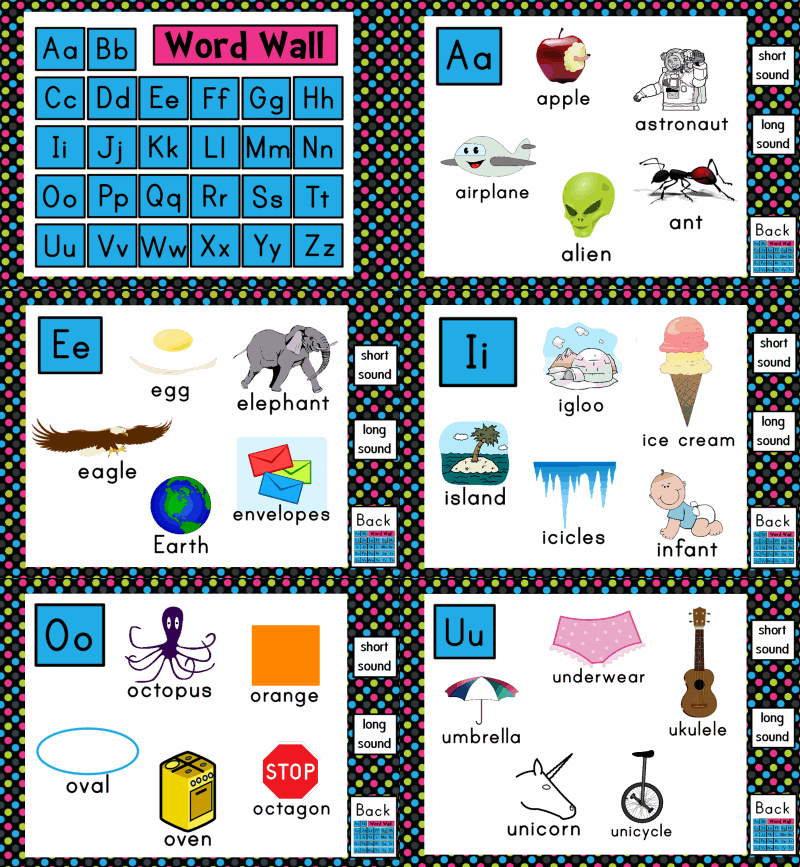
All about Word Wall
The Versatile, Humble and Interactive Vocabulary Building Tool
Word Wall has been in vogue for many many years. But the pity is either many teachers do not know about this or it is so humble a technique that many teachers ignore it. But, Word Wall is the most versatile resource.
It definitely is humble as the resources needed are also humble.
1. Wall or any plain surface. Next would be
2. Words / Vocabulary and then one needs3. chart paper and
4. bold markers.
How to create a Word Wall??
Again I browsed the internet. There are as many ways as there are teachers and students. The most important thing to keep in mind is that the words used must be
1. written /printed in bold characters and
2. visible clearly to all students at all times.
What words can be used in a Word Wall?? Anything and Everything that one wants to teach and reinforce.
Anything. a teacher can use his/her imagination in ways to use Word Wall. It can be used to teach Nouns, Adjectives, Adverbs, other Parts of Speech, Poetic Devices and what not. You can also use the Word Wall in other Subject Curriculum such as Science (Concepts, Formulae, Definitions), Social Science (special Vocabulary), Mathematics (Formulae) etc.
How to use a Word Wall??
Let me just take the example of what I did in my class. I used the VERBS used in a chapter of text in the Word Wall. Before beginning the chapter the Word Wall had all the verbs used in it.
When the chapter was being done I, again and again, referred to these verbs so that my students will be in constant touch with them. I gave them the correct pronunciation as well as spellings while referring to the words. This way, these words/verbs became part of my students' active vocabulary as they started getting comfortable and familiar with the words and were able to use most of them on their own. that is the reason why the students must be able to constantly be seeing them for some time, as in this case till a chapter is done.
Next comes the versatility of the Word Wall. As I had chosen verbs, I used the Word Wall to teach the other forms of these verbs. So my students came to grips with tenses too. I plan to take it to the next level when with the help of these words/verbs I will teach them grammar of tenses and how to use the various tenses in their speaking and writing. But that would come later on.
This way one can teach anything one wants to with a Word Wall. As I wanted to share this versatile yet simple vocabulary building tool with my fellow teachers I made a PowerPoint presentation of the features of Word Wall.
Then I heard about Prezi, another interesting presentation tool. I wanted to explore this and made a Prezi presentation of Word Wall too. I would like to share both of them on this blog.
Friday, 22 December 2017
Thursday, 14 December 2017
My first encounter with WORD WALL
And then...
I will now trace my Action Research journey.
https://1drv.ms/i/s!Aqa0uo7EZpQJjlovvKL8lsqshtXS
My question for Action Research was “Reading for pleasure is an important skill. Students and youngsters now-a-days just don’t have the inclination and interest for this simple pleasure. Almost all their language woes will be sorted once they get into the habit of reading especially reading for pleasure. So how to make my students take interest in reading?”
I started taking them to the school library and let them read ‘any’ book that interested them. This happened for about 4 weeks. But I couldn’t progress past teeny magazines with colourful pictures. I understood that they were plain ‘not’ interested in this supposed to be intellectual activity.
Meanwhile, I started a facebook page "Reading for pleasure’.
I diligently posted pictures, thoughts and lists of books to be read. But with my students, it was as if I had hit a brick wall.
After much pondering, I thought of problems faced by my students. As I discussed this with teachers of other subjects of the class, I understood that they have a problem of comprehending words. Vocabulary was their problem. So now I changed route and started my own research on how to tackle with this problem – the problem students face because of difficulty in understanding words and to use them.
Now I reframed my Action Research question to “there is a gap between words and their meaning. What can I do to decrease this gap?”
I put to use my close friendship with the ‘net’, to find out ways to decrease the word-meaning gap.
Lo!Voila! I hit pay dirt with WORD WALL!!!!
All about my encounter with this gold mine in the next post...
Sunday, 10 December 2017
The beginning of my Action Research Journey
British Council, India has been a part of my life since my college days. My friends used to tease me about my magnetic draw towards British Council Library, Chennai- ‘BCL’ - as we used to call it. I drank in Daphne du Maurier and Nevil Shute from the BCL and got teased for that too.
After a gap of
many years, British Council, Delhi came into my life in the form of
International School Award (ISA) when DAV Public School, sreshtha Vihar, Delhi,
applied for it and I was in the ISA core
team. Since then it has been a very fortuitous and fruitful association for me.
After twice accredited with the ISA, 5 teachers from the school were selected
by Principal Mrs Prem Lata Garg to work with mentors Mrs Suman Chawla and mrs
Chandeep Marwah for the Aptis Action Research Mentor Scheme (AARMS).


To quote Wikipedia, “Action research is
either research initiated to solve an immediate problem or a reflective
process of progressive problem solving led
by individuals working with others in teams or as part of a "community
of practice" to improve the way they address issues and solve
problems.”
The first
meeting was an exciting one as our mentors Mrs Chawla and Mrs Marwah are
dynamic personalities. They introduced us to Action Research, what it is and
how to go about it. It was intimidating to all five of us from the school, Ms
Preeti Bhatnagar, Ms Shweta Handa, Mrs Ranjana Varma, Ms Nupur Gupta and
myself. We wondered if we will be able
to take up the challenge of classroom research with all other duties as senior
teachers. With the reassurance and positive vibes of Ms Chawla and Ms Marwah,
we promised that we will take it up. As passionate teachers, we indeed wanted
to be change makers by bringing in small yet fantastic changes in our
classrooms.
In this exciting
journey we were joined by 5 teachers from Ramjas School, Karol Bagh. It was an
interesting mix of teachers of Chemistry, Computer Science and English from
primary to the senior classes. We were told to think of questions on which we
could base our action research. It could be “something which has been challenging
us in the class room or something which is a success but needed further
exploration”. The webinar led by our mentors’ guides Mr Amol and Mr Richard was
an eye opener as all of us were impressed and intrigues us the teacher from
Mexico and her action research. Through action research, she was able to find
out “how to end her lessons interestingly”. As teachers, we plan extensively
about how to introduce each lesson and ways to begin every class. We do not
give much thinking about how to end our classes. We just summarise and probably
exit the class. The webinar in detail spoke about this teacher’s research and
how she started practicing different interesting means to end her classes. Wow!
Just great!! we thought. Can we also practice such simple, interesting and
exciting things in our classroom?
We started discussing things then. And then...
Subscribe to:
Comments (Atom)